You can't test a page you've never seen.
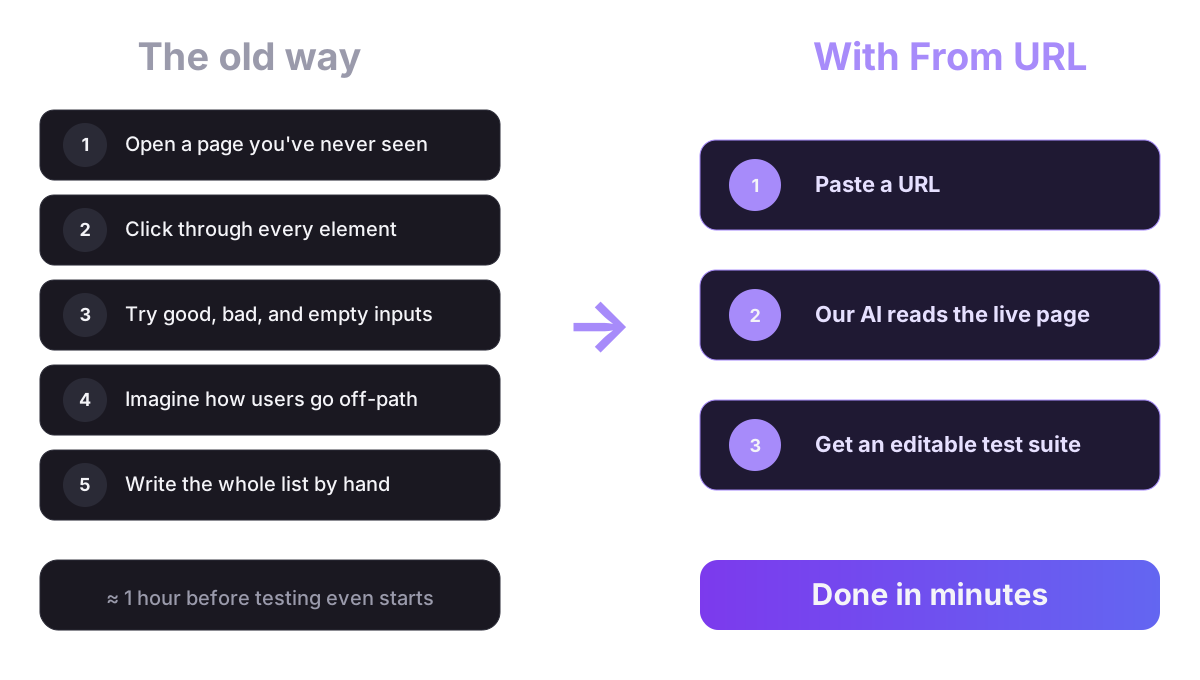
It sounds obvious, but it's the reason every new feature lands on your desk the same way. Before you can write a single test case, you have to figure out what's even on the page, so you open it and start clicking. Every button, to learn what it does. Every form, filled with good data, then bad, then nothing at all. You hunt for the empty states, the error messages, the edge cases a real user might stumble into, and you write each one down. An hour later you finally have your list, and only now can the actual testing begin.
That hour isn't testing. It's reconnaissance, and it's the most expensive, least visible part of a tester's day.
TestWise From URL was built to hand that hour back. You paste a link you get a complete, ready-to-run test suite. No clicking, no mapping, no blank page to stare down. Here's exactly how it works, and why it quietly changes the economics of testing for you and your whole team.
The hour you never budget for
The trap with that recon hour is that it's never a one-time cost. You don't pay it once and move on. You pay it again on every new page, every redesign, every feature you ship. Your testing workload doesn't scale with how much you build it scales with how much surface there is to map, and that number only ever climbs. Hire faster and ship faster, and the recon debt grows right alongside you. The most productive teams end up generating the most unmapped ground.
And the quality of that mapping rides entirely on who's doing it and how fresh they are. A rushed engineer late on a Friday misses what a sharp one catches first thing Monday. Because all of it happens before the "real" testing even starts, nobody tracks it. It's pure overhead hiding in plain sight, the cost no status report ever shows.
So teams do the only sensible thing left and cut corners. They test the obvious path, ship it, and hope the edge cases stay quiet. You already know how that tends to end, usually in a bug that a thorough first pass would have caught long before a user did.
Paste a link. Get a test suite.
The idea behind From URL is simple let the page tell us what to test, instead of making a person reverse-engineer it by hand.
You give TestWise one thing a URL. That's the whole input. No scripts, no setup, no recorded walkthrough. Just the address of the page you need to cover.
From there, our AI runs the reconnaissance for you, in seconds instead of an hour. It opens your live page in a real browser, exactly as a user would see it. The real page as it actually renders, not a guess based on the link. It reads everything on that page the buttons, forms, and flows a person sees, and the structure underneath that tells it a login form is a login form and not just two boxes and a button. Then it reasons about what genuinely needs testing the happy path, the empty fields, the bad inputs, the boundary cases a seasoned tester pokes at on pure instinct. It doesn't get bored on the tenth page or rush because it's late in the day, so the dull admin screen gets the same systematic sweep as the flagship feature.
And it writes them out as real, structured, editable test cases. Not abstract topics like "test the login." Concrete, specific cases that submitting the form with a blank email shows an inline error, that an invalid coupon is rejected cleanly, that the happy-path checkout completes and fires the right confirmation. Each one spelled out, each one yours to keep, tweak, or delete.
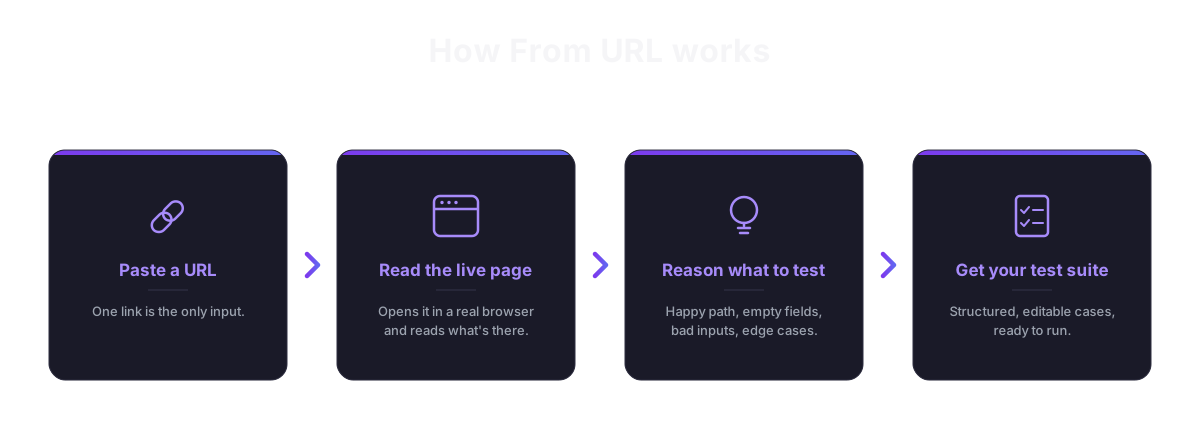
What lands in your workspace isn't a vague checklist. It's a finished test suite, ready to review and run. The blank page is gone. You start from a draft and spend your time refining it, not building it from nothing.
What this looks like on your next ticket
Picture the next new page that lands on you. Instead of opening it and bracing for an hour of poking around, you paste its URL into TestWise and step away to grab a coffee. By the time you're back, the reconnaissance is done. There's a full suite waiting, covering the obvious paths and the fiddly edge cases you'd otherwise have spent forty minutes hunting down. And it isn't one page at a time. Point it at each new page as it ships, and the groundwork for your whole release is handled in the time it used to take to map a single screen.
From there, your job is the part that was always worth your time reading through what the AI found, adding the one case it couldn't have known about because it only lives in your head, and deciding what "thoroughly tested" means for this particular feature. You're reviewing and judging, not discovering. The page that used to swallow your whole morning gets covered before lunch.
You spend your time on judgment, not busywork
The recon hour was never the valuable part of your work. The judgment was. It's knowing which behaviors actually matter, spotting the domain-specific edge case nobody else would think to check, and deciding when coverage is genuinely enough.
From URL doesn't touch any of that. What it strips away is the repetitive sweep that comes before it, the rote clicking and form-filling that drains your focus and is always the first thing to get skipped under pressure. Instead of reaching the interesting work already worn down, you start there. The AI hands you a thorough, consistent first pass you bring the expertise that turns it into real coverage. It's the same reason a senior tester's instinct is worth more than their click count the value was always in the thinking, and From URL just clears everything that was getting in the way of it.
What it does for the whole team
Step back from one engineer to the whole team, and the gains compound.
Coverage stops depending on who happened to grab the ticket. The same thorough first pass lands whether it's generated Monday morning or Friday at five, by your most senior tester or someone who started last week. Quality stops being a function of energy and seniority and becomes something you can count on.
Releases stop waiting on the bottleneck. When the slowest step of testing a new page drops from an hour to seconds, testing is no longer the thing holding up the ship. Features can get covered nearly as fast as they get built, and the gap between "it's done" and "it's tested" shrinks to almost nothing.
And the pages that used to get skipped finally get tested. When starting a suite costs an hour, the settings screen nobody touches and the obscure flow most users never reach get quietly waved through as "probably fine." When it costs the few seconds it takes to paste a link, there's no reason to skip them anymore. Coverage creeps into the corners of the product it never used to reach, not because anyone worked harder, but because being thorough stopped being expensive.
And the tests keep working
There's a long game here too. The tests From URL generates aren't pinned to brittle selectors that snap the moment a developer renames a CSS class or restructures the page. They're built on what a user actually sees and does, so when your interface changes but the experience doesn't, your tests don't light up red for no reason.
If you've ever maintained a traditional suite, you know how much time vanishes into that churn fixing tests that broke not because anything was actually wrong, but because the page moved underneath them. From URL gives you coverage that holds up as your product evolves instead of coverage you have to babysit. It compounds release after release, rather than quietly decaying until no one trusts it.
Skip the hour
Testing a new page used to start with an hour of clicking. Now it starts with a link.
Paste a URL into TestWise and watch a full test suite write itself, then run it, edit it, and keep it working as your product grows.
From URL doesn't replace your judgment. It just makes sure you spend it on testing, not on figuring out what to test.